Sunday, 10 October 2010

Institute of Education Seminar

The latest in the Engaging Geography series, which was originated by the late Duncan Fuller, and now organised by his great friend and colleague (and fellow Geography Collective member) Kye Askins is being held on Wednesday of this week at the Institute of Education.

Here are the details.
I shall be 'recording' as much of the events as I can to help with my nascent MA studies, and own professional development....
If there is phone reception, I shall be tweeting from the event too... some amazing speakers...


Date: 13th October 2010
Venue:
 Room 836, Institute of Education, University of London, 20 Bedford Way, London WC1 H 0AL 
Convenors: David Lambert (Geographical Association / Institute of Education) and John Morgan (Institute of Education)
Programme:
10.30: tea/coffee
11.00: Introduction to the day.
  • Introductions [10 mins]
  • David Lambert: Do we have to say what geography is? To whom? [10 mins]
11.20: Session one. ‘Setting the scene and whetting the appetite.’
  • Professor Alastair Bonnett: Geography in public. Geography as one of humanity’s big projects? [20 mins]
  • Dr Jessica Pykett: The public in geography. Can the public(s) be identified? (20 mins]
  • Discussion: [10 mins]
12.15: Lunch & informal discussion [Room 802: 30-40 mins]
1.00: Session two. ‘Particular settings and perspectives’.
Key elements and participants (10-15 minutes each, including questions) are as follows. Contributors are encouraged to provide specific instances, examples or case studies to illustrate or exemplify the points they wish to make.
2.30 pm Discussion: Michael Young: what is a Powerful Knowledge?
Michael Young is a distinguished Professor of Education at the Institute of Education. The disciplinary basis for his research is the sociology of knowledge, represented by two career spanning and important books:
Young, M. (1971) Knowledge and Control. London: Collier Macmillan.
Young, M. (2007) Bringing Knowledge Back In: From social constructivism to social realism in the sociology of education. London: Routledge.
Michael will provide a 20 minute input, possibly picking up on matters arising from the above, plus further time for questions.
3.15: Tea break
3.30: Session 3. ‘In what ways is geography a powerful knowledge to communicate, and to whom?’
1. Pairs or threes [40 mins]
Write down (in a form that can be left with the seminar organisers):
  • specific ways in which geography is a ‘powerful knowledge’
  • particular ‘publics’ who need access to geography as a powerful knowledge (and why)
2. Feedback-discussion, based on a ‘one-minute headlines’ from each group [30 mins]
4.40: Brief round-up and short break
5.00: Session 4. School Textbook Archive (with wine and nibbles)
Launch of the Geography School Textbook archive: a fully catalogued collection at the Institute of Education, assembled by donation and financial assistance from the Frederick Soddy Trust.
Opening up opportunities to study the ‘knowledge of the powerful’ and ‘powerful school curriculum knowledge’ in the context of school geography. With Ashley Kent, Emeritus Professor of geography Education and leader of the archive project.
6.00: Depart

Monday, 4 October 2010

Lobby your MP

The Geographical Association is asking geography teachers, and others with an interest in ensuring that geography keeps its place in the school curriculum, to lobby their MP.
The reasons for this are fairly clear, when one considers that there are many schools now which don't offer Geography at GCSE level, and there are also pressures on curriculum time lower down the school. At Primary, student experiences of geography are patchy, although there are many excellent schools, a growing number of which hold the Primary Geography Quality Mark as a way of celebrating their commitment.

Lobbying your MP sounds like it might involve a lot of hard work, but it actually takes just a few minutes.

Visit the GA's website page on LOBBYING YOUR MP.

Print off the letter that has been written as a template for you to use.
You might want to add your address, and also edit it to add your own thoughts.

You can also print out and include a copy of the latest document, written by John Hopkin and David Lambert.

Put it in an envelope - the address is on the website...
Then, importantly, please TELL US WHICH MP YOU HAVE CONTACTED so that we can keep a track of who has been suitable "lobbied"...
Thanks in advance for your support with this.

And by the way, it works...
I received a reply from my MP...

New Teaching Geography now available for download...

The latest issue of Teaching Geography is now available to download by those who subscribe to it....

It features a range of inspirational articles on the theme of place by Mark Jones, Eleanor Rawling, Becky Kitchen, Margaret Roberts and others...
Articles range from a teacher visit to Greenland, to the urban re-branding and renaissance of Scarborough...

To add a subscription to your GA membership, or to join (and gain access to the last five years of journals in electronic format) click the JOIN THE GA link.

Saturday, 2 October 2010

Controlled Assessment Videos by Dave Holmes

2 great videos made by Dave Holmes.
The first is shot in London and provides some simple ideas for ethnographic fieldwork data collection.... "people watching"...


The second is particularly helpful.
It is a short video featuring Nick Blunsum: the Head of Geography at Kingsmead Community School


What's great is that Nick talks about the impact of going through the process of gaining the Geographical Association's Secondary Geography Quality Mark.

He talks about "evaluating what was good and developing areas that needed improvement" and also "giving back some of the control to students to stop the lessons being too teacher led..." - some good advice on controlled assessment too....

Thanks for sharing these Dave, and to @GeogAdviser for the tip off on Twitter....

Sunday, 12 September 2010

Cape Farewell: a voyage around Svalbard

The Cape Farewell voyages aim to bring a cultural response to the issue of Climate Change.

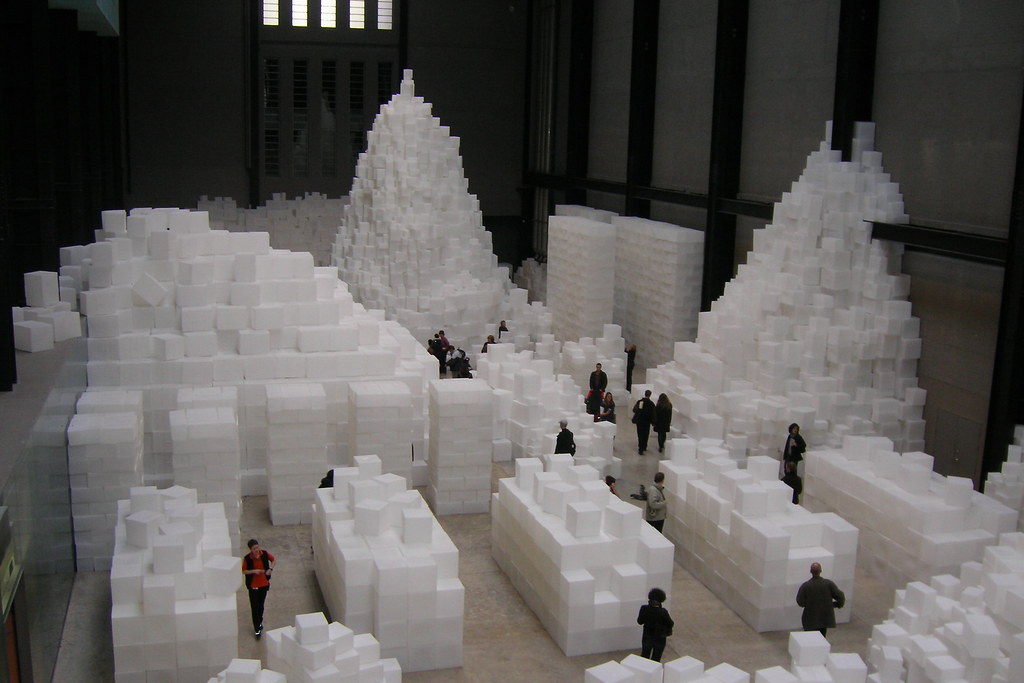
Previous voyages involved Anthony Gormley, and Rachel Whiteread, who was inspired to fill the turbine hall at Tate Modern with white cubes.

When teaching the now sadly ex-Pilot GCSE Geography course a few years back, I used the Cape Farewell pack that the Geographical Association produced.
The blog posts that relate to my studies of this EXTREME ENVIRONMENT are available by following THIS LINK to the blog: you'll see student work and a range of other resources which I hope you might still find useful...

The latest Cape Farewell expedition is going to follow the route shown on the map above, and it has JUST SET OFF... you can follow if for the next few weeks by visiting the CAPE FAREWELL WEBSITE, or following CAPE FAREWELL on TWITTER.

Monday, 6 September 2010

NQT Survival Kit now 'live' on the GA website

Welcome back to the new academic year !
I hope the first day is going well. My daughter started secondary school today, and my son a new primary school, so my educational adventure continues over 40 years since I first passed through the doors of my own first school: Northfield Lane Infants School, Wickersley.
For those starting school as a teacher for the first time, the GA has produced a new resource: an NQT SURVIVAL KIT.

If you know an NQT, please direct them to this resource: a lot of it is not 100% geography specific: it's just solid advice...

This is not a 'completed resource'. We would really appreciate any updates for the resource - send us your experiences, thoughts, ideas and tips for fellow colleagues who are starting out on their professional journey.

Sunday, 5 September 2010

David Lambert in the TES

Just caught up with the publication of a piece by Professor David Lambert in the TES, published on the 27th of August, while I was away on holiday. I saw the original piece, and haven't checked yet for any possible editing of the piece for publication. It was titled "Crack curriculum's core and open a world of opportunity"


If politicians want more focus on knowledge, subject teachers should decide what is crucial
The Government appears determined to reform the school curriculum again. This is something that some teachers may resist - it will appear as yet more change, when not enough time has been allowed for the last alterations to settle. And because of the return to "knowledge" as opposed to "skills", changes could be accompanied by much Gradgrind-sounding rhetoric about facts and old-fashioned subjects.
It could sound like a rush to restore a golden age of subjects past, and undo the curriculum reforms of the last government. However, if we can just stop dodging the imagined swinging pendulum for one minute, perhaps we can see a more progressive future, which is in teachers' hands. Teachers should seize this chance to get stuck into the knowledge question rather than collectively avoid it, which has in some ways been the story of recent times.
The professional language invented over the past 10 years is the language of pedagogy. This is no bad thing in itself, of course, but pedagogy has become so dominant that it is now confused with its apparently weaker cousin: curriculum. But it is the curriculum that teachers need to engage with.
At present, the subject curriculum is often referred to as the vehicle to "deliver" transferrable skills. This is wrong. It is pedagogy - the skills of doing and thinking - that is the vehicle. The curriculum is about the destination, the aims and goals, and is therefore a matter of serious moral deliberation.
Skills, on the other hand, are said to be value-free. But what shall we teach and how do we justify this? These are the important questions and they ought to be informed by what we think young people need to know.
The curriculum, like pedagogy, is about choices. It is, therefore, a part of what we have come to know as "professional judgment".
In the case of curriculum, the choices concern the selections of knowledge we try to teach. We make these selections according to principles we value, governed by our sense of educational purpose.
A curriculum shaped by whim, the topics in the news and contemporary themes of "relevance" - or, worse still, policy imperatives laid down by the Government - is likely to be incoherent, shallow and like junk food: deeply unsatisfying after the initial fat and sugar rush.
So this is why the subject disciplines matter. Geography is a good case in point. It is an ancient human fascination: its big idea is to try to make sense of ourselves at home on planet Earth. Mapping the world was, and is, fundamental. Today the project is augmented by all kinds of technologies including geographical information systems. But it is useful to consider for one moment what it means to know a bit of geography.
This is particularly important because these days, thanks to the internet and Google Earth, sat-nav and mobile phones, everyone knows some geography. Furthermore, we all have a geographical existence: we live somewhere, shop somewhere and have relatives and friends dotted around the globe.
This realisation has encouraged a lot of interest in "everyday geographies" - but again, let us pause for thought. Is our interest in everyday geographies curriculum-based or is it more a matter of pedagogy? Every teacher knows the strengths of working from the known and what is familiar to children - this is sound pedagogy. But in curriculum terms it is a betrayal not to move to the unknown and unfamiliar. Curriculum goals must be in the driving seat.
Part of the unknown for most young people consists of what is sometimes called "core knowledge", a component of our cultural literacy. This includes locational knowledge - also known as geographical facts, or what the Geographical Association's manifesto refers to as the subject's "vocabulary".
It is important to embrace this in school because this knowledge is not easily developed in everyday life. And yet, it is knowledge that helps make sense of information encountered in everyday life. It helps us function in society. If there is a move to identify subject essentials, or core knowledge, let us engage with it at face value. Instead of shrinking from the curriculum debate, it is time for teachers to take back intellectual responsibility for their work.
- The Geographical Association manifesto is at: www.geography.org.uk/adifferentview
HOW DOES 'CORE KNOWLEDGE' FIT IN GEOGRAPHY?
The good news is that absolutely necessary core knowledge is not a large component of the geography curriculum. It can be taught via the regular use of atlases, occasional quizzes and other enjoyable and simple devices that form part of the repertoire of careful teaching.
It can be thought of as the extensive knowledge base upon which more intensive geographical case studies and inquiries can acquire deeper contextual meaning. To illustrate: can we really expect to be able to engage with global climate change meaningfully, without a mental framework that would include naming the oceans and some of the world's ocean currents? Without such knowledge, we are literally disabled to some degree.
We can incorporate it, as many careful geography teachers already do, into the broader geography curriculum. Geographical vocabulary is powerful, but so, too, is its grammar or syntax captured by its key ideas such as place, space and environment.
A person growing up in the 21st century as a global citizen (and all that implies) is at a disadvantage without geographical knowledge - economically, culturally and politically. How can we make any of the personal decisions that already confront us every day about energy, food and water security without geographical knowledge?
Understanding geographical perspectives contributes to our capabilities as educated individuals and members of society.
Professor David Lambert, Chief executive of the Geographical Association